Step 08TQT does thisAfter Production · Before Good weld

Proof the weld is good.

NDT

Nondestructive testing · VT · PT · MT · UT

NDT checks a finished weld for flaws without cutting or breaking it. The part passes inspection and goes back to work. We test in our lab or at your shop.

Quoted per jobfull day onsite · by the hour in our lab
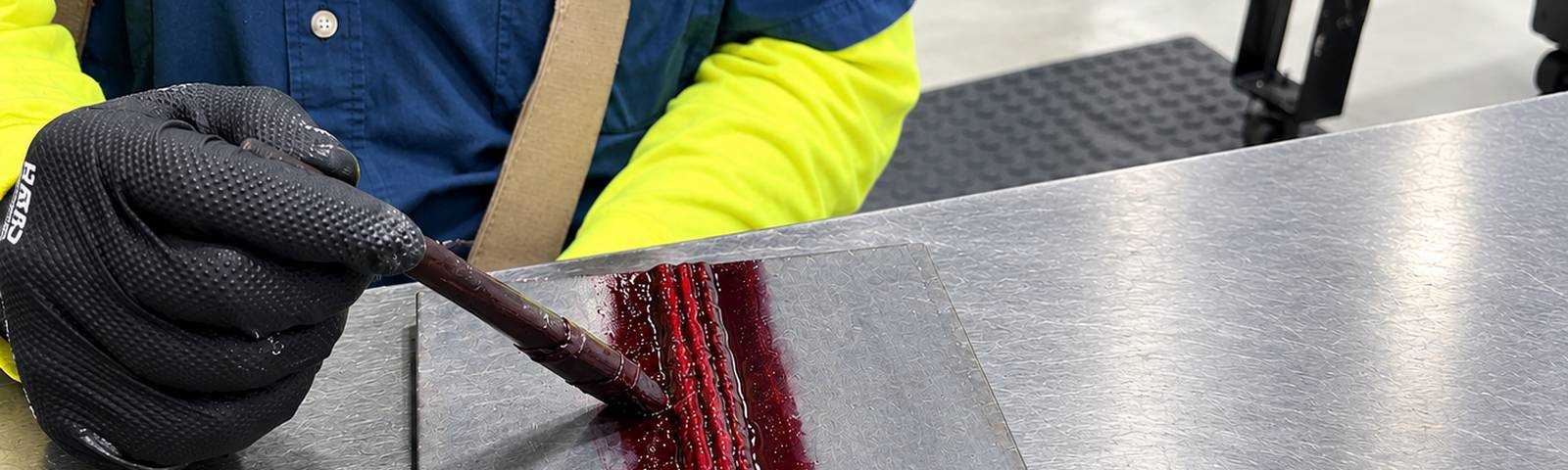
PT · DYE PENETRANT Technician brushing red dye penetrant onto a weld test plate
Red dye finds surface cracks. It soaks into any opening, then a developer pulls it back out where you can see it.
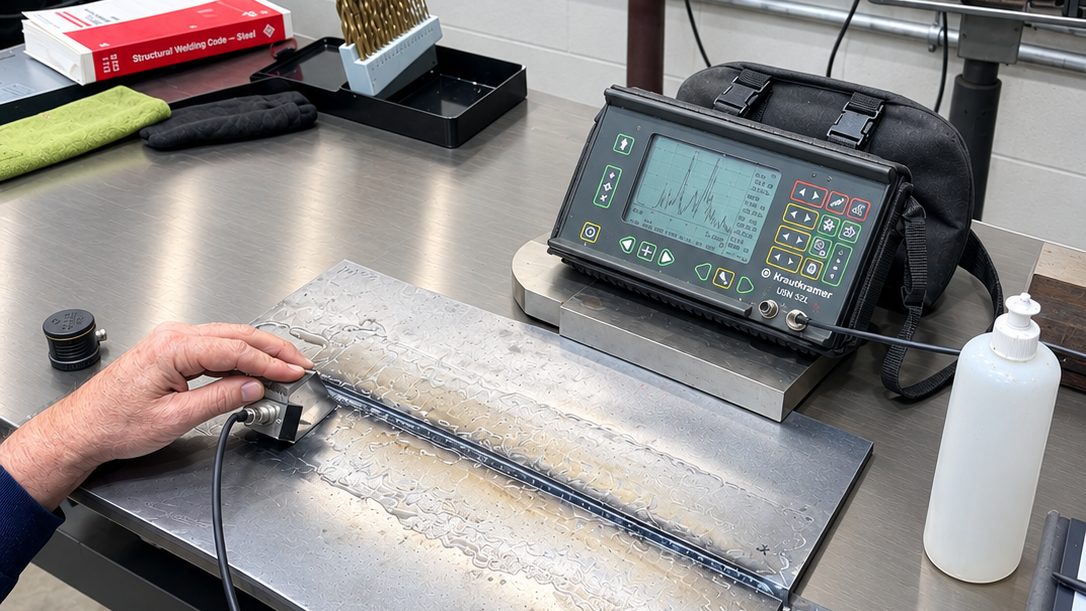
UT · ULTRASONIC Technician scanning a weld plate with an ultrasonic flaw detector
Sound sees inside the weld. A probe sends sound through the steel. Flaws echo back as spikes on the screen.
In the kitchen

The taste test. Check the plate before it leaves the kitchen, without taking a bite out of it.

The methods

Five ways to look at a weld

Each method sees to a different depth. Four are done at TQT. Radiography is sent out. Below the chart, each test is explained step by step.

MethodSurfaceJust belowFull depthWhere
VTVisualLab · Onsite
PTLiquid penetrantLab · Onsite
MTMagnetic particleLab · Onsite
UTUltrasonicLab · Onsite
RTRadiographicSent out

What each test does

VTVisual TestingStep 1, every time

A trained inspector looks closely at the finished weld, with good light, a magnifier and weld gauges.

  1. Clean the weld so the surface can be seen.
  2. Look over the whole weld under strong light.
  3. Measure size and shape with weld gauges.
Finds
Wrong weld size or shape, undercut, overlap, surface porosity, visible cracks, arc strikes
Works on
Any metal
Limits
Only sees the surface. Problems inside the weld need another test.
PTLiquid PenetrantAlso called dye penetrant

A bright red dye soaks into tiny cracks you can't see, then a white coating draws it back out so the crack shows up as a red line.

  1. Clean the surface and brush or spray on red penetrant.
  2. Let it soak in, then wipe the surface clean.
  3. Spray on white developer. Red lines and dots mark the flaws.
Finds
Cracks and pinholes that are open to the surface, even very fine ones
Works on
Any non-porous metal, including aluminum and stainless steel
Limits
The flaw must break the surface. The part has to be very clean.
MTMagnetic ParticleFast on carbon steel

The weld is magnetized. A crack disturbs the magnetic field, and fine iron powder sprinkled on top gathers right along the crack.

  1. Place a magnet (a yoke) across the weld.
  2. Dust or spray on fine iron particles.
  3. Particles pile up in a line wherever there's a crack.
Finds
Cracks on the surface and just below it
Works on
Magnetic steels only, like carbon and low-alloy steel
Limits
Won't work on aluminum or most stainless. Can't see deep inside the weld.
UTUltrasonic TestingSees inside the weld

A probe sends sound waves through the metal, like sonar. A flaw inside the weld bounces the sound back, and it shows as a spike on the screen.

  1. Spread gel on the metal so the sound can travel in.
  2. Slide the probe along beside the weld.
  3. Read the echoes. The screen shows where a flaw is and how deep.
Finds
Hidden flaws through the full thickness: lack of fusion, cracks, trapped slag
Works on
Most metals, best on thicker welds
Limits
Needs a skilled technician to read the screen. Very thin parts are harder.

RT · Radiographic Testing takes an X-ray picture of the weld, kept as a permanent record. TQT sends RT out. Call for a quote.

Which one do I need?

Pick a method in two questions

A starting point. Your code or customer may name the method for you.

What metal is it?
What are you looking for?
START WITH VT, THEN MT

Magnetic particle. Fast and sensitive on carbon steel, and finds cracks just below the surface too. PT also works.

Pass or fail

What happens after the test

✓ PASS

Released

The weld is accepted, documented and good to go. Good weld →

↺ FAIL

Back to the welder

Retrain, requalify, re-inspect. The welder goes back through WPQ.

Field · Lab

At your shop, or at ours

Onsite

We come to you.

For parts too big to move, or a run of production welds. Check open dates first.

Book an onsite visit →

Lab

Bring it to Brook Park.

Coupons, test plates and parts that travel. Drop off any time during our operating hours. No appointment needed.

Lab hours →

How it works

From request to report

  1. Tell us the job

    The part, the code and the method, if you know it.

    YOU
  2. Set the date

    Onsite visit or lab drop-off.

    TQT
  3. We inspect

    VT first, then PT, MT or UT as needed.

    TQT
  4. You get the report

    Acceptable or rejected for each weld, against your code.

    TQT

Price

What NDT costs

NDT Quoted per job

Onsite is booked by the full day. In our lab, it's billed by the hour.

Request a quote See all rates →
Onsite
Full-day rate, plus mileage at 72.5¢ a mile to and from your site.
In house
Billed by the hour at our Brook Park lab.
RT
Sent out. Call for a quote.
Terms
Net 30. 4% fee on card payments.

Questions

Before you book

Can you use magnetic particle on aluminum or stainless?

No. MT only works on magnetic steels. For aluminum and most stainless we use liquid penetrant (PT) for surface flaws, or UT for inside the weld.

Who does the inspection?

Inspectors certified to ASNT SNT-TC-1A, Level II in each method.

Which codes do you inspect to?

ASME Section IX, ASME B31.1, ASME B31.3, AWS B2.1, AWS D1.1, AWS D1.2, AWS D1.3, AWS D1.5, AWS D1.6, AWS D1.9, AWS D9.1, AWS D14.1, AWS D15.1 and AWS D17.1, plus customer specs.

How fast do I get results?

Visual, PT and MT results the same day. The written report takes 5–7 business days for standard turnaround.

Need welds inspected?

Tell us the part and the code. We'll pick the method and the date.